
How Do Robotic Mowers Navigate? Wires, GPS, and Cameras
Robotic mowers find their way around a lawn using a combination of boundary wires, radio beacons, GPS, camera vision, or a mix of these systems, and the method a given model uses determines how much setup, mapping, and supervision it needs. Most affordable models still follow a buried perimeter wire, while newer wire-free mowers build a digital map of your yard and navigate by satellite positioning plus onboard sensors.
Key Takeaways
- Boundary wire mowers are the cheapest and most reliable in tight yards, but you must bury or peg a wire around the lawn’s edge.
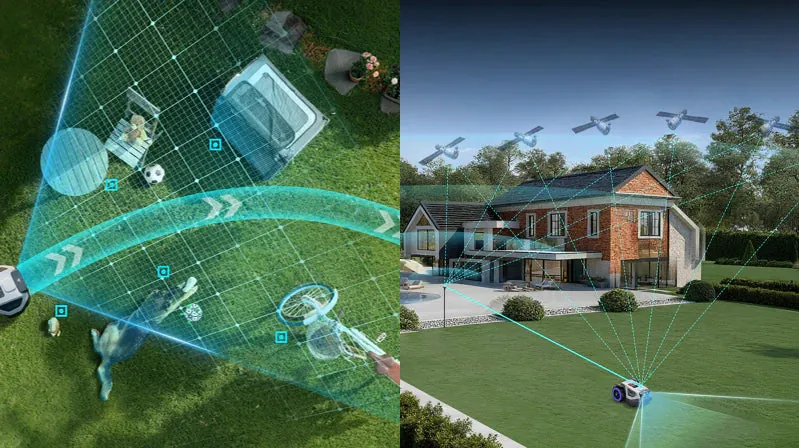
- Wire-free GPS/RTK mowers navigate by satellite correction signals and need a clear view of the sky to hold a straight line.
- Camera and LiDAR models build a map by watching landmarks, so they handle shade and obstacles without a perimeter wire.
- Random navigation bounces around until the lawn is covered; systematic navigation mows in planned stripes and finishes faster.
- Obstacle handling relies on bump sensors, ultrasonic sonar, or visual recognition, and each has different blind spots.
- Most mowers return to a charging dock by retracing a guide wire or following a recorded path, then resume where they left off.
How Robotic Mowers Navigate: The Four Main Systems
Every robotic mower answers the same question — “where am I, and where have I already cut?” — but the technology it uses to answer varies widely. There are four approaches on the market today, and many mid-range and premium mowers combine two of them.
| Navigation system | How it works | Setup effort | Best for |
|---|---|---|---|
| Boundary wire | A buried or pegged wire carries a low-voltage signal the mower follows | High (install wire) | Simple, shaded, or irregular yards |
| GPS + RTK | Satellite positioning corrected by a fixed base station | Medium (place base) | Open lawns over a quarter acre |
| Camera / vSLAM | Onboard cameras track visual landmarks to build a map | Low (drive it once) | Yards with trees, beds, and toys |
| LiDAR | Laser pulses measure distances to build a 3D map | Low | Complex layouts with many obstacles |
Boundary Wire Navigation
A perimeter wire loops around the lawn and, on many models, a second guide wire runs to the charging dock. The mower’s sensors detect the magnetic field the wire emits and treat it as an invisible fence. It cuts until it hits the boundary, turns, and continues.
The system is mature, inexpensive, and works in deep shade where cameras and satellites struggle. The trade-off is installation: you either trench the wire a few inches down or peg it on the surface, and a break in the wire stops the mower until you find and repair it.
GPS and RTK Navigation
Wire-free mowers from brands like Husqvarna, Segway, and Mammotion use GNSS receivers combined with RTK (real-time kinematic) correction. A base station on your property compares satellite signals against a known fixed point and sends corrections to the mower, tightening accuracy from a few yards to roughly an inch.
That precision lets the mower mow in parallel stripes and remember exactly which zones are done. The catch: RTK needs a clear view of the sky. Dense tree canopy, tall buildings, or a mower parked under a deck can degrade the signal and cause skipped strips.
Camera and Visual Navigation
Camera-based mowers use vSLAM — visual simultaneous localization and mapping. As you drive the mower around the yard during setup, or as it explores, it photographs landmarks and stitches them into a map. On later runs it matches what the camera sees against that map to know its position.
These mowers handle shade and narrow side yards better than GPS-only units. They can also recognize and avoid pet waste, toys, and hedgehogs in models that advertise AI obstacle detection. Performance drops in heavy rain, at night, or when a landmark like a parked car moves.
LiDAR Navigation
LiDAR fires laser pulses and times their return to measure distances, building a precise 3D map of the yard. It works in darkness and doesn’t depend on visual texture, which makes it strong in complex gardens. LiDAR mowers are typically the most expensive category and still less common than wire or GPS systems.
Random vs. Systematic Mowing
The navigation method also decides how the mower covers ground, and this affects how long a full cut takes.
- Random navigation: The mower travels in changing directions and angles until statistical coverage is reached. It’s simple and cheap, but a full lawn may take several sessions.
- Systematic navigation: The mower plans parallel passes or a spiral, covering the lawn once in a predictable pattern. It finishes faster and leaves visible stripes.
Wire-based mowers historically used random patterns; GPS and camera mowers almost always mow systematically. If finishing speed matters, prioritize a mower with mapping.
How Mowers Handle Obstacles and Slopes
Navigation isn’t just about the boundary — it’s about everything inside it.
- Bump sensors detect contact and reverse the mower. Reliable but scuffs the object.
- Ultrasonic sonar detects solid objects before contact. Struggles with soft or low obstacles.
- Camera AI recognizes objects and steers around them. Needs decent light and training data.
- Lift and tilt sensors stop the blades if the mower is picked up or tips on a slope.
Pro Tip: For yards with slopes, check the rated climbing angle (often 25–35%) before buying. A mower that navigates well on flat ground can still slide or lose traction on a wet incline, and GPS accuracy often degrades on steep banks.
How Robotic Mowers Find the Charging Dock
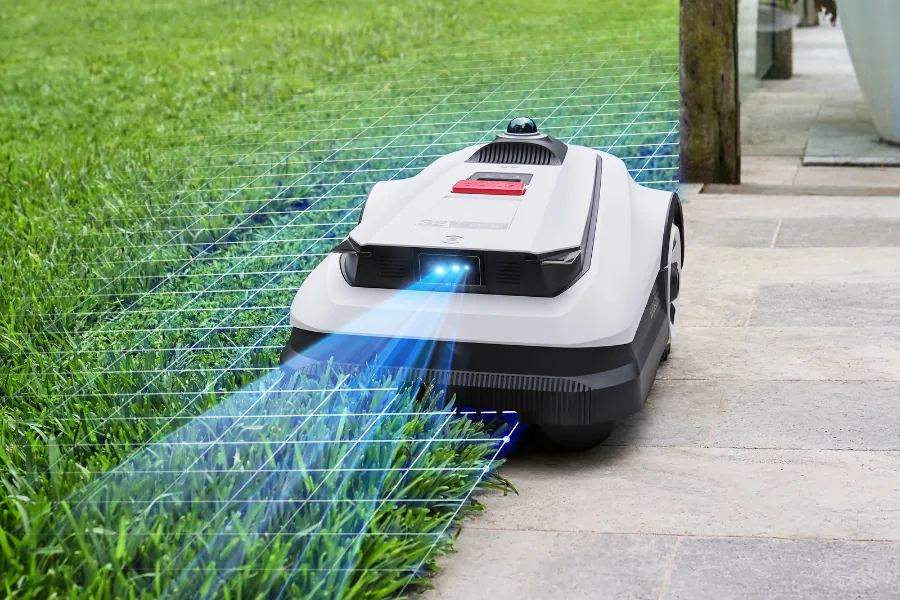
Returning home is its own navigation problem. Wire-based mowers follow the guide wire back to the dock. Wire-free mowers either retrace a recorded path or navigate to the dock’s GPS coordinates and then use a short-range signal — infrared, radio, or a visual marker — for the final docking approach.
Most mowers dock automatically when the battery drops to a set threshold (commonly 15–20%), recharge for roughly 60–90 minutes, then resume. Models with zone memory pick up where they stopped rather than starting over.
The Role of Sensors and Safety Standards
Beyond navigation, mowers carry a suite of sensors: rain sensors to delay cutting, gyroscopes and accelerometers for heading, and blade-stop sensors for safety. Robotic mowers sold in the US fall under safety requirements for automatic lawnmowers, and reputable manufacturers build to international standards covering blade-stop time and obstacle detection.
Warning: Never disable or bypass lift, tilt, or boundary sensors. They’re the primary protection for children and pets, and defeating them voids the warranty and creates real injury risk.
Setting Up Navigation Correctly
Getting navigation right is mostly a setup job, not a hardware one.
- Map or wire the whole perimeter, including flower beds you want excluded.
- Create no-go zones for ponds, sandboxes, and steep drop-offs.
- Position the charging dock on level ground with clear sky above (for GPS) or near a power outlet (for wire).
- Place the RTK base station high and clear of buildings, ideally with a wide view of the sky.
- Run a test cycle and watch for missed strips, wire faults, or repeated stuck points.
- Adjust the schedule to mow more often in growing season so each pass is short.
Troubleshooting Navigation Problems

| Symptom | Likely cause | Fix |
|---|---|---|
| Mower stops at the same spot | Wire break or tight corner | Locate the fault with a wire tracer; widen the corner |
| Skips strips or wanders | Weak GPS/RTK signal | Move the base station; trim overhanging branches |
| Won’t dock | Dirty dock contacts or blocked approach | Clean contacts; clear the path to the dock |
| Gets stuck on roots or toys | Obstacle detection blind spot | Add a no-go zone; remove the object |
| Erratic behavior after rain | Wet sensors or slippery wheels | Let it dry; check tire tread |
Pro Tip: Keep firmware updated. Navigation improvements — better mapping, smarter obstacle avoidance — often arrive as free over-the-air updates rather than new hardware.
Related guides
Frequently Asked Questions
Do robotic mowers need Wi-Fi to navigate?
No. Navigation itself runs on the wire signal, GPS, or onboard cameras and sensors. Wi-Fi is only needed for app control, scheduling, firmware updates, and remote monitoring. A mower can cut a full lawn with no internet connection at all.
Can a robotic mower work without a boundary wire?
Yes. Wire-free models from Husqvarna, Segway, Mammotion, and Worx use GPS/RTK, camera vision, or LiDAR to build a virtual boundary. They cost more upfront but skip the wire installation, which matters most in established lawns you don’t want to dig up.
How accurate is GPS navigation on a robotic mower?
Plain GPS is accurate to a few yards, which is too loose for mowing. Adding RTK correction from a fixed base station tightens it to roughly an inch, which is why nearly every wire-free mower pairs GPS with RTK rather than relying on satellites alone.
What happens if the mower loses its position?
Most models stop, alert you through the app, and wait rather than cutting blindly. Some retrace their last known path or return to the dock. Persistent position loss usually points to a wire fault, a blocked RTK antenna, or heavy canopy.
Do robotic mowers navigate in the dark?
Wire-based and LiDAR mowers can run at night since they don’t depend on light. Camera-based mowers generally cannot, because vSLAM needs visible landmarks. Night mowing is common in Europe but less so in the US, where many owners prefer daytime runs.
How long does it take to map a yard?
Wire installation takes a few hours for a typical quarter-acre yard. GPS and camera mowers usually need one guided setup lap, often 20–45 minutes, plus a test run to confirm boundaries and no-go zones before the first full schedule.
Conclusion
Once your mower’s navigation is dialed in, the routine becomes boring in the best way: it leaves the dock, cuts its zones, and returns without input. Start by confirming which navigation system fits your yard’s shade, slope, and size, then invest your setup time in accurate boundaries and no-go zones — that single step prevents most of the stuck-mower and missed-strip complaints owners report.

Daniel Carter is a home improvement specialist and tool researcher with years of experience studying power tools, hand tools, workshop equipment, outdoor gear, and DIY projects. At HomeToolWorld, he researches products, compares features, reviews manufacturer specifications, and creates practical buying guides to help homeowners, DIY enthusiasts, and professionals make informed decisions. His goal is to provide accurate, easy-to-understand, and trustworthy content based on careful research and real-world applications.