
Are Robotic Lawn Mowers Safe? Hazards and How to Avoid Them
Robotic lawn mowers are safe for most households when installed and used as directed, but they aren’t risk-free: the main hazards are the spinning blades, the boundary wire, and the battery, and every one of those risks is manageable with correct setup, supervision of pets and children, and routine maintenance.
Key Takeaways

- Modern robotic mowers rely on lift and tilt sensors that stop the blades within seconds when the unit is picked up or tipped, which is the single biggest safety feature to check before buying.
- The blades are small, pivoting, and razor-style rather than a single fixed bar, so cuts tend to be shallow — but they still require keeping children and pets out of the mowing zone while the unit runs.
- Most serious incidents trace back to installation errors, not the machine: boundary wire laid too close to a drop-off, a driveway, or a play area.
- Battery and charging safety matters more than most buyers expect; use only the manufacturer’s charger and keep the dock dry and ventilated.
- No robotic mower is a toy or a babysitter — treat it like any other power tool with a scheduled maintenance routine.
What to Look for in Safe Robotic Lawn Mowers
Manufacturers converged on a similar safety package over the past decade, and it’s worth knowing the names so you can compare spec sheets.
Lift and tilt sensors are the core protection. When the mower is lifted off the ground or tipped past a set angle, power to the blade motor cuts almost instantly. This is why you can safely pick up a running unit — though you should still stop it first out of habit.
Obstacle detection uses either bump sensors (the mower taps an object, backs up, and turns) or, on newer models, camera or radar-based systems that slow the unit before contact. Bump sensors are reliable but mean the mower does touch objects; vision systems avoid contact but cost more.
Boundary and guide wires keep the mower inside a defined area. Some newer models use GPS or a virtual map instead, which removes the wire but adds its own considerations around signal accuracy.
Emergency stop is usually a button on the unit or a command in the app. Know where it’s before the first run.
How the Blades Actually Cut
The blade system is the part people worry about most, and it’s also the most misunderstood.
Robotic mowers typically use two to four pivoting razor blades on a disc. They aren’t rigidly fixed — they swing freely, so when they hit something hard they fold back rather than forcing through it. The cutting height is usually 1 to 4 inches, and the mower takes small slices off the top of the grass rather than a deep cut.
That design is why injuries from these machines tend to be minor lacerations rather than the deep, powered injuries associated with a push mower or ride-on. It isn’t a reason to be casual about them. A child who picks up a running mower, or a dog that lies down in its path, can still be cut.
Warning: Never disable or tape over a lift sensor, and never run a mower with a cracked or missing blade disc. Both are the exact conditions under which the standard protection stops working.
Installation Mistakes That Cause Accidents
Most incidents reported by owners come down to where and how the mower was set up.
| Installation mistake | Why it’s dangerous | Fix |
|---|---|---|
| Boundary wire too close to a drop-off or retaining wall | Mower can tip over the edge | Keep wire at least 12–16 inches back from any drop |
| Wire crossing a driveway or public path | Mower enters traffic or trips pedestrians | Use a guide wire to route around, or set a no-go zone |
| Dock placed on a slope or in standing water | Charging faults, electrical risk | Level, dry, shaded spot near an outlet |
| No exclusion zone around a sandbox or play set | Mower enters a child’s play area | Map a no-go zone in the app or with wire |
| Pets’ water bowls or toys left on the lawn | Mower hits them, or pet investigates the blades | Clear the lawn before each scheduled run |
Pro Tip: Walk your lawn once at the mower’s cutting height before the first run. Anything you wouldn’t want a spinning blade to touch — garden hose, extension cord, low-hanging fruit — should be moved or excluded.
Are They Safe Around Children and Pets?

The honest answer is: safe if you manage the schedule, not safe if you leave everyone unsupervised.
Schedule mowing for times when children and pets are indoors — early morning or during school hours works well for many households. Most apps let you set a mowing schedule and a rain delay, so you aren’t guessing.
For pets specifically, the risk isn’t usually aggression toward the mower. It’s curiosity. A dog that chases or bites at the unit can end up with a nose or paw injury. Training the animal to stay away, or fencing the mowing zone, solves it.
For children, the bigger risk is treating the mower as a ride-on toy or a remote-control car. Keep the PIN lock enabled — most models have one — so nobody can start it manually.
The U.S. Consumer Product Safety Commission maintains guidance on outdoor power equipment safety that applies to robotic mowers as well; the principles of keeping bystanders clear and never servicing a machine while it’s powered are the same. You can review the CPSC outdoor power equipment safety guidance for the general framework.
Battery, Charging, and Electrical Safety
The lithium-ion pack inside a robotic mower is the same chemistry as a laptop or e-bike battery, and the same rules apply.
- Charge only with the supplied dock and adapter. Third-party chargers with the wrong voltage are a common cause of battery fires in all lithium devices.
- Keep the dock dry. A dock in a low spot that floods is an electrical hazard, not just a warranty problem.
- Don’t charge in extreme heat. A dock in direct summer sun can push cell temperatures into a range that shortens life and, in rare cases, causes thermal events.
- Store the battery at partial charge if you’re putting the mower away for winter — most manufacturers recommend roughly 50 percent.
- Replace swollen packs immediately. A puffed battery is a failing battery.
Weather, Slopes, and Terrain Limits
Every mower has a rated maximum slope, usually between 15 and 35 degrees. Exceeding it causes wheel slip, tip-overs, and boundary escapes.
| Condition | Safe to run? | Notes |
|---|---|---|
| Light rain | Usually yes | Most units are rated IPX4 or better |
| Heavy rain or standing water | No | Risk to electronics and traction |
| Wet, steep slope | No | Slip risk, boundary failure |
| Frost or snow | No | Blades and drive motors can be damaged |
| Lightning within earshot | No | Unplug the dock |
Pro Tip: If your lawn has a slope steeper than the mower’s rating, do not “test” it. Either terrace the lawn, exclude the slope, or buy a model specifically rated for steep terrain.
Maintenance That Keeps It Safe
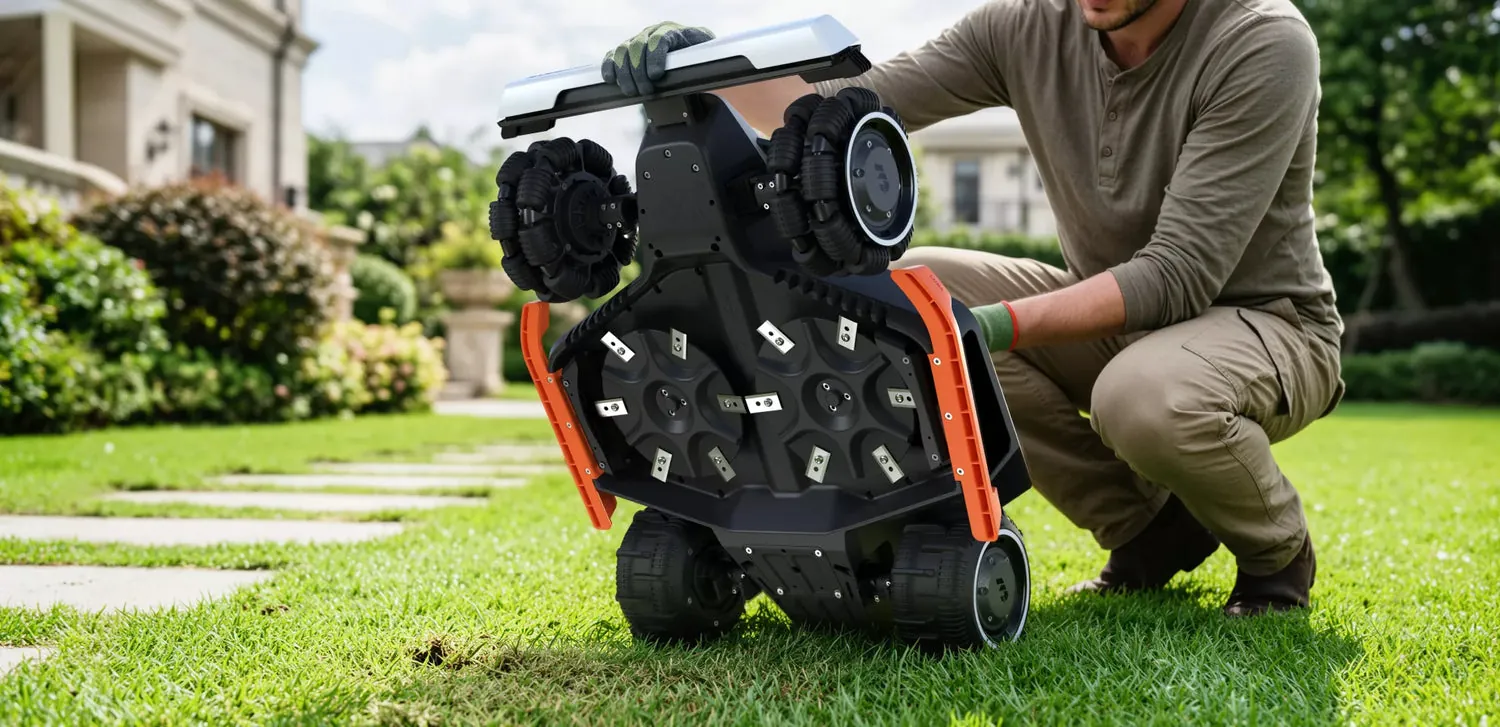
Safety features degrade quietly. A sensor clogged with grass clippings behaves like no sensor at all.
- Clean the underside and blade disc every couple of weeks during mowing season.
- Check blade screws for tightness monthly; a loose blade is an unpredictable blade.
- Inspect the boundary wire for nicks and breaks, especially after aerating or edging.
- Test the lift sensor by lifting the mower a few inches while it runs — the blade should stop.
- Update firmware when prompted; manufacturers do push safety fixes.
- Clean the charging contacts on both the mower and the dock.
Frequently Asked Questions
Can a robotic lawn mower cut a person?
Yes, but typically only superficially. The pivoting razor blades and lift sensors mean most contact results in a shallow laceration rather than a deep wound. Serious injuries are rare and almost always involve someone overriding a safety feature or handling a running mower.
Do robotic mowers stop for animals?
Most models have bump sensors that reverse the mower when it contacts an obstacle, and some newer models use cameras or radar to slow down beforehand. They don’t reliably detect a sleeping cat or a small hedgehog before contact, which is why scheduling runs when pets are indoors is the safer approach.
Are robotic mowers safe in the rain?
Most are rated for light rain and will return to the dock automatically when a rain sensor triggers. Running them in heavy rain or through standing water isn’t recommended because of traction loss and moisture ingress into the electronics.
Do I need to fence off the lawn?
Not necessarily, but you do need to keep children and pets out of the mowing area while it runs. Boundary wire or a mapped no-go zone handles the mower’s side of the equation; supervision handles yours.
Is it safe to leave a robotic mower running overnight?
Many owners do, and most manufacturers support it. The trade-off is that you can’t see what is on the lawn in the dark. If you have nocturnal wildlife, pets that go out at night, or children who might wander, schedule daytime runs instead.
What happens if the mower hits a rock or a toy?
The blade disc usually stalls or the mower bumps and turns away. Repeated impacts with hard objects will chip the blades and can crack the disc, so clear obvious debris before each run and inspect the blades monthly.
Conclusion
A robotic mower is one of the safer power tools you can put on a lawn — provided you install it properly, set a sensible schedule, and keep up with basic maintenance. Start by reading your model’s slope rating and sensor specifications, then walk your lawn and mark anything the mower should avoid before you run it for the first time.

Daniel Carter is a home improvement specialist and tool researcher with years of experience studying power tools, hand tools, workshop equipment, outdoor gear, and DIY projects. At HomeToolWorld, he researches products, compares features, reviews manufacturer specifications, and creates practical buying guides to help homeowners, DIY enthusiasts, and professionals make informed decisions. His goal is to provide accurate, easy-to-understand, and trustworthy content based on careful research and real-world applications.