
How Do Robotic Lawn Mowers Work? A Simple Guide
A robotic lawn mower is a battery-powered machine that cuts grass on its own, following a boundary you define and returning to a charging dock when its battery runs low. You still set the schedule, the cutting height, and the perimeter, but the mowing itself happens without you pushing anything.
Key Takeaways
- Robotic mowers cut a little at a time, frequently, which is why they leave a healthier lawn than a weekly scalp-and-bag session.
- Your three setup choices are boundary type (buried wire vs. GPS/RTK), dock location (shade, power, flat ground), and schedule (daily is normal).
- Most models handle slopes up to roughly 20–35%, but wet grass, deep shade, and steep banks are where they fail.
- Expect to trim edges, clean the underside, and replace blades every 4–8 weeks during the growing season.
- Budget $700–$3,500 for the mower itself, plus $100–$400 if you hire someone to install a wire boundary.
- Rain sensors, lift sensors, and bump sensors are standard; GPS anti-theft and cellular tracking are the premium add-ons.
How Robotic Lawn Mowers Work to Cut Grass
Under the shell, a robotic mower is simple: a battery, two or more drive motors, a cutting disc with small pivoting blades, and a control board. The disc spins at roughly 2,000–3,000 rpm, and the blades are free-swinging razor blades rather than a single sharpened bar.
Because the blades pivot, they retract slightly when they hit a twig or a toy instead of shattering. That’s also why robotic mowers mulch rather than bag — the clippings are tiny enough to fall between the grass plants and break down, feeding nitrogen back into the soil.
The machine never cuts very much at once. A typical pass removes just a few millimeters, which is why the mower runs almost every day rather than once a week. This is the single biggest behavioral change for new owners.
Why Frequent Light Cuts Win
Grass responds to severe cutting by shutting down growth and yellowing at the tips. Taking 2–3 mm a day keeps the plant in constant mild growth, so the lawn stays dense and the clippings disappear. If you skip a week, the mower may not keep up and you’ll see visible clumps.
How It Knows Where to Go
Navigation is the part people ask about most, and there are two main systems.
Boundary wire is the classic approach. You (or an installer) lay a thin cable around the lawn’s perimeter and around any islands — flower beds, trees, a sandbox. The wire carries a low-voltage signal, and a sensor on the mower detects it. When the mower approaches, it turns around. A second wire, or a guide wire, leads the mower back to the dock.
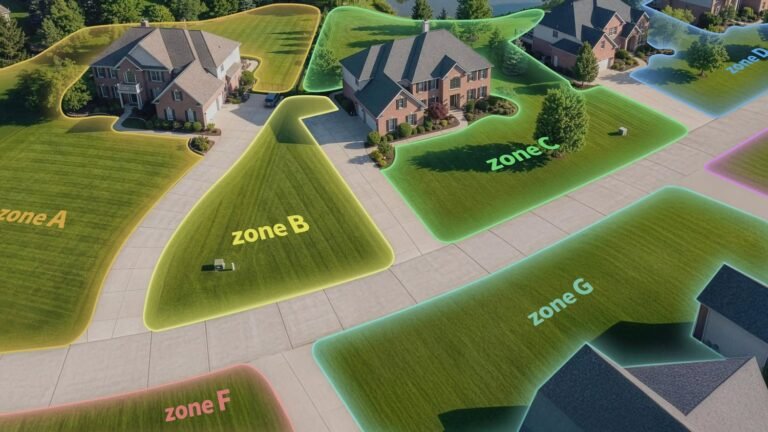
GPS/RTK systems use satellite positioning corrected by a fixed reference station on your property. Instead of a physical wire, you map the lawn by driving the mower around the perimeter once, and the mower stores that map. These handle complex yards and multiple zones better, and they usually cost more.
The Random vs. Systematic Difference
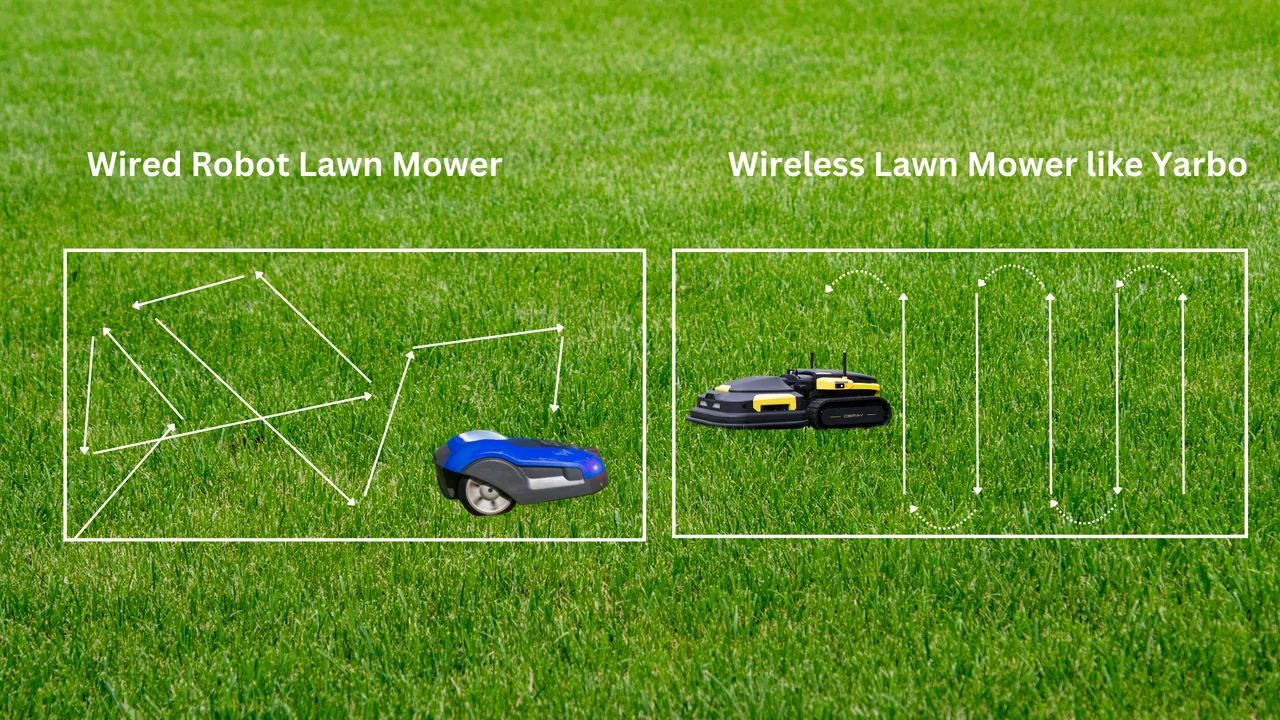
Early wire-based mowers moved in a random pattern, bouncing off the boundary until the whole lawn was covered by chance. Modern wire and GPS models often mow in parallel stripes or a systematic pattern, which finishes the lawn faster and looks tidier. If coverage time matters to you, this is worth checking in the spec sheet.
The Setup Process, Step by Step
| Step | What You Do | Typical Time |
|---|---|---|
| 1. Plan the boundary | Walk the yard, note obstacles, slopes, and narrow gaps | 30–60 min |
| 2. Choose dock site | Near a weatherproof outlet, on flat ground, in partial shade | 20 min |
| 3. Lay the wire or map | Bury or peg the cable, or drive the mower to map GPS zones | 2–6 hours |
| 4. Connect and charge | Wire into the charging station, mower to dock | 1 hour |
| 5. Set schedule | Height, days, start time, rain delay | 15 min |
| 6. Observe first week | Watch for stuck spots, adjust wire or map | Ongoing |
If you hire a dealer, installation typically runs $100–$400 depending on yard complexity. The Consumer Product Safety Commission publishes recall and safety notices for outdoor power equipment, which is worth checking before you buy any brand.
Getting the Dock Right
The dock matters more than people expect. It needs a power outlet within reach of the low-voltage cable, flat ground so the mower can align itself, and shade if possible — a dock in full sun cooks the battery over a summer. Keep it within about 10 feet of the lawn edge so the mower doesn’t have to travel far.
What They Handle Well — and What They Don’t
Robotic mowers are excellent on flat to gently sloping, unobstructed lawns under about half an acre. They struggle with:
- Steep banks over roughly 35% grade, where wheels slip
- Wet grass, which clogs the deck and leaves ruts
- Deep shade, where grass grows slowly and the mower overworks bare patches
- Narrow strips under about 3 feet wide, where the mower can’t turn
- Heavy spring growth, when grass outpaces a daily cut
Warning: Never run a robotic mower on a slope steeper than the manufacturer’s rating. A mower that loses traction on a wet hill can slide into a street, a pool, or a road.
Maintenance: The Real Schedule
| Task | Frequency | Notes |
|---|---|---|
| Rinse underside | Weekly in growing season | Scrape off clippings, don’t hose the electronics |
| Check blades | Every 2 weeks | Replace when dull or nicked |
| Replace blades | Every 4–8 weeks | Kits cost $15–$40 |
| Clean charging contacts | Monthly | Dirt blocks charging |
| Check boundary wire | Seasonally | Look for nicks from edgers and shovels |
| Battery check | Annually | Expect 3–5 seasons of life |
Blades are the consumable that surprises new owners. Because the blades are small and the mower runs daily, they dull faster than a push mower’s single blade — but they’re also cheap and swap out in a couple of minutes.
How Much They Cost to Run
Electricity is minimal: a robotic mower uses roughly the same power as a small appliance over a season, typically a few dollars a month in most US markets. The real costs are the machine, installation, and blades.
- Entry-level wire models: $700–$1,500
- Mid-range with app control and GPS: $1,500–$2,500
- Premium GPS/RTK, large lawns, steep slopes: $2,500–$3,500
- Professional installation: $100–$400
- Annual blades and parts: $40–$120
Common Problems and Fixes

- Mower stuck in the same spot: usually a soft patch, a root, or a hole. Fill it or add a no-go zone.
- Not returning to dock: dirty charging contacts, a damaged guide wire, or a dock that has shifted.
- Leaving uncut strips: blade height set too low, or the schedule is too short for the lawn size.
- Stops in the rain: most models have a rain sensor; check whether it’s set to delay or to stop entirely.
- Alarm going off at night: lift or tilt sensor triggered — often a raccoon, sometimes a loose wheel.
Frequently Asked Questions
Do robotic mowers need a boundary wire?
Not always. Wire-free models use GPS with RTK correction, or camera-based navigation, to stay inside a mapped area. Wire systems remain cheaper and more reliable under tree cover, where GPS signal is weak.
Can a robotic mower handle a yard with a dog?
Yes, with caveats. Most mowers have lift and tilt sensors that stop the blades if the unit is picked up, and the blades are small. Still, schedule mowing for when pets are inside, and pick up waste before the mower runs.
How long does the battery last per charge?
Typically 45–90 minutes of cutting, then 60–90 minutes of charging. Larger lawns simply mean more cycles per day, which is why the mower runs on a repeating schedule rather than one long session.
Will it mow in the rain?
Most models sense rain and return to the dock, then resume later. Some premium models cut in light rain. Running in heavy rain risks clogging and slipping, so leaving the rain delay on is usually the better choice.
What happens if it’s stolen?
GPS-equipped models can be tracked through the app, and some include cellular modules and geofencing alarms. Wire-only budget models generally have no tracking, so insurance or a locked gate is your protection.
Do I still need a trimmer?
Yes. Robotic mowers can’t reach against fences, foundations, tree trunks, or bed edges. Plan on 10–20 minutes of string trimming every week or two during peak season.
Is a Robotic Mower Right for You?
It fits if your lawn is mostly flat, under about half an acre, and free of obstacles you’d have to move constantly. It fits poorly if your yard is steep, heavily shaded, or full of narrow passages. The honest trade-off is this: you trade a weekly hour of pushing for a small amount of weekly maintenance and a significant upfront cost.
Measure your lawn, check the slope with a level app, count your obstacles, and then compare that against the slope and area ratings on the spec sheet before you buy anything.
Start by measuring your lawn’s square footage and its steepest slope this week — those two numbers alone will eliminate most of the models you were considering and point you at the two or three that will actually work in your yard.

Daniel Carter is a home improvement specialist and tool researcher with years of experience studying power tools, hand tools, workshop equipment, outdoor gear, and DIY projects. At HomeToolWorld, he researches products, compares features, reviews manufacturer specifications, and creates practical buying guides to help homeowners, DIY enthusiasts, and professionals make informed decisions. His goal is to provide accurate, easy-to-understand, and trustworthy content based on careful research and real-world applications.