Can Robotic Mowers Mow Artificial Grass? What to Check First
Yes, most robotic mowers can mow artificial grass, but only if the grass is short-pile and firmly fixed down. If your turf is long-pile or loose-laid, the mower will drag, snag or stall. Check your turf pile height and how it’s anchored before you set a boundary wire.
When artificial grass works with a robotic mower
Short, dense turf that’s glued or nailed down handles a robot fine. Long, soft blades and loose edges don’t.
| Your situation | Answer | Why |
|---|---|---|
| Short-pile turf, glued down | Yes | Blades stay upright, mower glides |
| Long-pile turf, 30 mm+ | No | Blades bend, mower drags and stalls |
| Loose-laid turf, no fixings | No | Mower lifts edges and snags |
| Turf on firm, flat base | Yes | Wheels grip, no sinking |
| Turf with pet mess | Usually not | Smears waste, hard to clean |
| Mixed real and fake grass | Yes, with care | Mower crosses both fine |
| Steep sloped artificial lawn | No | Wheels slip on plastic blades |
The pile height is the number that matters most. Most robotic mowers are built for real grass cut to 20–60 mm, so turf in that range sits comfortably. Check your turf’s pile height in its product documentation before you commit.
What decides whether your mower copes
Pile height and how the turf is fixed decide almost everything. A robotic mower cuts by spinning a small blade under a floating deck. On real grass, the blade slices clean stems. On artificial grass, there’s nothing to slice — the blade just brushes over plastic filaments. So the mower isn’t really cutting; it’s mostly rolling and lightly tidying.
That changes what matters. Blade sharpness stops being important. What matters is whether the mower’s wheels can roll without the turf bunching up, and whether the blades stay upright under the deck. Short filaments spring back. Long, soft filaments fold flat and wrap around the blade housing.
The fixing matters just as much. Loose-laid turf has edges that lift. A robot’s drive wheels catch those edges, and over weeks the seams start to pull apart. Turf that’s glued, nailed or weighted down stays put.
Battery life also drops on artificial grass. Plastic filaments create more rolling resistance than real grass, so the mower works harder. Expect shorter runs per charge — check your mower’s manual for its rated run time and treat it as a best case.
If your turf is short-pile and firmly fixed, then go ahead; if it’s long-pile or loose, then don’t.
Setting it up so the turf survives
- Measure your pile height first. Look at the turf’s spec sheet or measure a single filament with a ruler. If it’s under 25 mm, you’re in good shape. If it’s over 30 mm, stop here.
- Walk the edges and press them down. Any edge that lifts under a finger will lift under a mower. Re-fix loose edges with turf adhesive or galvanized nails before you install anything. The sign it worked: no edge moves when you press it.
- Lay the boundary wire inside the turf edge. Keep it at least 20 cm from any flower bed or fence. On artificial grass you can often tuck the wire under the turf instead of burying it. The sign it worked: the mower turns before it reaches the edge.
- Set the cutting height to its highest setting. This keeps the blade just brushing the surface instead of pressing into the backing. The sign it worked: the mower moves smoothly with no buzzing or stalling.
- Run one supervised test cycle. Watch the full first mow from start to finish. If the mower stalls, spins its wheels or leaves drag marks, raise the height again or stop and reconsider.
- Clean the underside weekly. Plastic filaments and dust collect under the deck. Wipe it out with a damp cloth. The sign it worked: no buildup when you check.
The mistake that ruins the turf
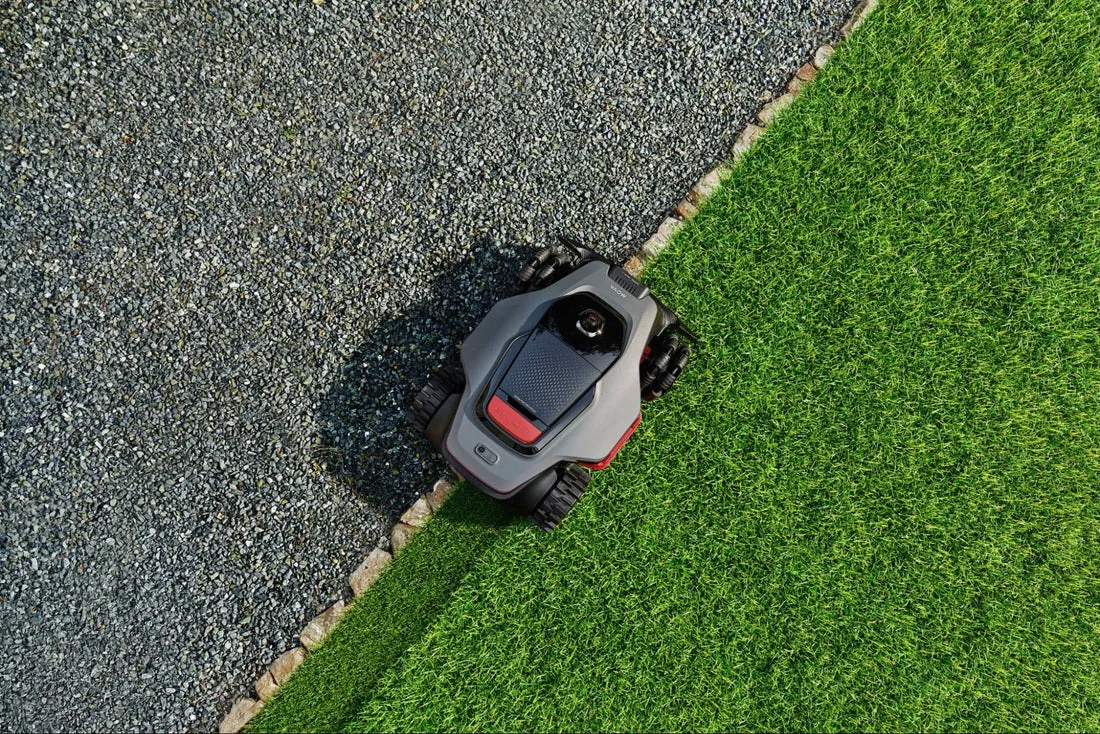
Running the mower at a low cutting height is the mistake that costs people their lawn. It seems logical — lower means a tidier look. On artificial grass it does the opposite. A low deck presses the blade into the backing, and the drive wheels grind the filaments against the base.
The damage shows up slowly. First the turf looks flattened in stripes. Then those stripes stay flat even after rain or brushing. By the time it’s obvious, the pile in those tracks won’t spring back, and you’re looking at replacing sections of turf.
The check that avoids it: set the deck to its highest setting and leave it there. Watch the first few mows for drag marks. If you see any, raise it again. There’s no cutting benefit to going lower on plastic.
When to call a turf specialist
- The turf lifts at the seams — a fitter can re-glue and re-stretch it properly.
- The pile stays flat after brushing — the backing may be damaged, and a specialist can assess it.
- Water pools on the surface — the base layer needs re-doing, which means lifting the turf.
- The mower stalls in the same spot every time — a turf fitter can check for a hump or dip in the base.
- You want the wire buried under the turf — this needs cutting and re-seaming, a job for a professional.
None of these are dangerous, but all of them involve lifting or cutting turf. Get a trained artificial grass fitter to handle it.
Frequently asked questions
Can a robotic mower cut artificial grass?
It can run over it, but it doesn’t really cut it. There’s nothing to slice — the blade just brushes the plastic filaments. The mower mostly tidies and rolls the surface. That’s why pile height and firm fixing matter more than blade sharpness.
Why does my robotic mower stall on artificial grass?
Stalling usually means the pile is too long or the deck is set too low. Long filaments wrap around the blade housing and jam it. Raise the cutting height to its highest setting and check the pile height in your turf’s documentation. If it’s over 30 mm, the mower likely won’t cope.
How long should I run a robotic mower on artificial grass?
Run it for shorter cycles than you would on real grass — often half the normal run time per session. Plastic filaments create more rolling resistance, so the battery drains faster. Check your mower’s manual for its rated run time and treat that as a maximum, not a target.
Is it safe for the mower and the turf?
Yes, at the right height. The mower itself isn’t damaged by artificial grass. The turf is the risk — a low deck grinds the filaments and flattens the pile. Keep the deck high and clean the underside weekly, and both last longer.
Does it matter if my artificial grass is long-pile?
Yes, it matters a lot. Long-pile turf, roughly 30 mm and above, is where most mowers fail. The filaments bend instead of standing, wrap around the blade, and stall the motor. Short-pile turf under 25 mm is the safe zone.
What happens if the turf isn’t fixed down?
The mower’s wheels catch the loose edges and lift them. Over a few weeks, seams pull apart and the turf shifts. You’ll see ripples and open joins. Fix the edges with adhesive or nails before you run any mower on it.
Can I use a robotic mower if I have pets?
It’s possible but messy. A mower running over pet waste smears it across the turf and into the blade housing. You’ll need to pick up waste before every cycle and clean the deck more often. Many owners decide it’s not worth the hassle.
Do I still need to brush artificial grass?
Yes. Brushing lifts the pile back up and spreads the filaments evenly. A robotic mower can flatten the pile over time, especially in wheel tracks. Brush every few weeks, and more often in the tracks where the mower runs.
Check your turf before you buy the mower
Measure your pile height and press down every edge before you spend anything on a robot. If the turf is short-pile and firmly fixed, expect the mower to roll over it smoothly with no drag marks — that’s your sign it’s working. If the mower stalls, spins or leaves flattened stripes after two or three cycles, stop and call a turf fitter.
Daniel Carter is a home improvement specialist and tool researcher with years of experience studying power tools, hand tools, workshop equipment, outdoor gear, and DIY projects. At HomeToolWorld, he researches products, compares features, reviews manufacturer specifications, and creates practical buying guides to help homeowners, DIY enthusiasts, and professionals make informed decisions. His goal is to provide accurate, easy-to-understand, and trustworthy content based on careful research and real-world applications.