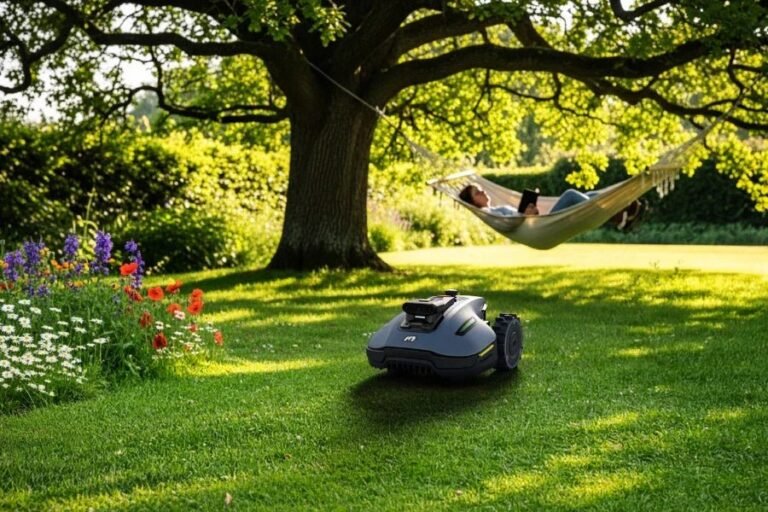

Robotic Mower for Sloped Yard: Slope Ratings and Setup
A robotic mower for sloped yard work needs a slope rating higher than your steepest patch — most models handle 15–25°, and a few reach 35°. You’ll also need the right tires and a boundary wire or GPS map. This guide covers the numbers, the setup, and when a slope is simply too steep.
What a robotic mower for a sloped yard is

A slope-rated robotic mower is a robot that cuts grass on ground that isn’t flat. It uses its drive motors, wheel grip, and tilt sensors to stay upright and keep cutting. Most are built for lawns around a house, not for wild hillside.
The robot follows a boundary wire or a GPS map, then cuts in a pattern inside that zone. When it tilts past its limit, a sensor stops the blades. That cut-off is a safety feature, not a sign of a fault.
The common misconception is that any robot mower can handle any hill. It can’t. Slope rating is a hard limit set by the maker, and going past it means the mower slides, loses its line, or stops on the hill. Check the maker’s own spec sheet for the exact degree figure before you buy.
Setting up a mower on a slope
- Measure your steepest patch first. Use a phone level app or a straight edge with a spirit level. Write down the worst angle, not the average.
- Compare that number to the mower’s rating. If your hill is 22° and the rating is 20°, pick a stronger model or plan a flat zone.
- Lay the boundary wire at least 12 inches from the bottom edge of any slope, so the mower doesn’t run off it.
- Space the wire so the mower crosses the hill at an angle. Straight up-and-down passes cause slipping and ruts.
- Fit the traction kit the maker sells — usually studded or wider wheels. On wet grass, these make the biggest difference.
- Set the cutting height 1 notch higher than you would on flat ground. Taller grass hides ruts and holds the wheels better.
- Run the first full cycle while you watch it. Note where it struggles, then adjust the wire or the schedule.
The one judgement call is speed. A slower pass on a slope gives the wheels time to grip. If you push the mower to cover the hill faster, it slips, and the ruts get deeper each week.
If your slope is near a public path, a road, or a drop of more than a few feet, a robot mower isn’t the right tool — talk to a landscape contractor about terracing or a retaining wall instead.
Slope ratings and settings at a glance
Ratings below come from makers’ own spec sheets, so always confirm the figure for your exact model. Angles are the maximum the mower is rated for, on dry grass.
| Situation | What to use | How long | What to watch for |
|---|---|---|---|
| Gentle slope, under 15° | Standard robot mower, normal wheels | Full cycle, as scheduled | Wet grass grip |
| Moderate slope, 15–25° | Slope-rated model with traction kit | Add 20–30% to cycle time | Wheel slip and ruts |
| Steep slope, 25–35° | Top-tier slope model, studded wheels | Split into two shorter cycles | Tilt cut-off stops |
| Very steep, over 35° | No robot mower — use a brush cutter or pro service | Not applicable | Safety and rollover |
| Slope plus tight corners | GPS-mapped model, no boundary wire | Full cycle, watch first runs | Mapping errors on banks |
| Slope in shade, damp soil | Slope model, higher cut height | Shorter cycles, more often | Moss and soft ground |
| Slope next to a drop | Boundary wire 12+ inches from edge | Full cycle | Run-off at the edge |
What separates a clean slope cut from a mess
Experienced owners set the boundary wire before the mower ever arrives. They walk the hill, mark the steepest point, and plan the wire route so the robot crosses the slope on a diagonal. That single choice decides whether you get a clean cut or a set of ruts.
They also run the mower in dry conditions for the first week. Wet grass is where grip fails, and a mower that slips once will slip in the same spot again. Watching the first few cycles tells you more than any spec sheet.
Preparation beats power
A higher slope rating helps, but preparation helps more. Sharp blades, the right cut height, and a wire route that avoids straight climbs do most of the work. Owners who skip this step blame the mower for a problem the setup caused.
What they leave alone
They don’t mow a soaked hill, and they don’t chase every stray blade. Letting the robot run its normal schedule keeps the grass short enough that the slope stays firm. Cutting too low on a bank exposes soil, and exposed soil turns into mud after rain.
Common slope problems and fixes

| What you notice | What it usually means | What to do first |
|---|---|---|
| Mower stops mid-hill | Tilt sensor hit its limit | Check the angle against the rating |
| Wheels spin, grass tears | Not enough grip | Fit the traction kit, raise cut height |
| Mower drifts off the lawn | Boundary wire too close to the edge | Move the wire 12+ inches inward |
| Uneven cut on the bank | Straight up-and-down passes | Re-route the wire for diagonal crossing |
| Deep ruts appear | Repeated slipping in one line | Change the route, mow when drier |
The rules and limits that apply
Slope ratings are set by each manufacturer, and they’re the number that matters most. A rating of 20° means the mower is designed to hold that angle on dry grass — not on wet grass, and not on loose soil.
In the US, cordless outdoor power equipment like robotic mowers falls under Consumer Product Safety Commission rules for battery safety and product labeling. Check the CPSC’s guidance on lithium battery charging and storage if you’re unsure how to store yours.
For anything beyond a standard lawn — a steep bank near a road, a retaining wall, or a slope over 35° — hire a licensed landscape contractor. That work carries real injury risk, and it’s not a do-it-yourself job.
Keeping the slope mowed long term
Once it’s running, keep the blades sharp and check the wheels every few weeks. Dull blades tear grass on a slope, and torn grass recovers slower than a clean cut. Clean the underside when grass builds up, since a heavy deck strains the motors on a climb.
Watch for new ruts after heavy rain — that’s your sign the route needs a change. Bring the mower inside before winter, charge the battery to the level the maker states in its manual, and store it dry. The maker’s own manual is the source for your model’s storage figure.
When a robot mower isn’t the right choice

If your slope runs past 35°, no mainstream robot mower is rated for it. Use a brush cutter or hire a pro service instead.
If the hill is wet most of the year, or the soil is soft and loose, the mower will slip no matter what you fit. Terracing or a ground cover like creeping thyme works better than grass there.
And if the slope sits next to a road, a drop, or a public path, the run-off risk is too high. A robot mower is a lawn tool, not a safety barrier — get a contractor to look at the site first.
Frequently asked questions
Can a robotic mower handle a sloped yard?
Yes, if the slope is within the model’s rating — most handle 15–25°, and top models reach 35°. Measure your steepest patch first. If it’s past the rating, pick a stronger model or keep that section for a brush cutter.
What slope can a robotic mower climb?
It depends on the model. Entry-level mowers usually top out around 15–20°, mid-range models reach 25°, and a few high-end models are rated to 35°. Always check the maker’s spec sheet, since the figure changes by model and by wheel type.
How do I stop my mower from slipping on a hill?
Fit the traction kit the maker sells, raise the cutting height by 1 notch, and only mow when the grass is dry. Route the boundary wire so the mower crosses the slope on a diagonal instead of climbing straight up.
Is it safe to run a robot mower on a steep slope?
It’s safe within the maker’s rating, because the tilt sensor stops the blades if the mower leans too far. Past that angle, the mower can slide or tip. For slopes over 35°, or any bank next to a road or drop, use a pro service instead.
How long does a robotic mower take on a sloped lawn?
Expect 20–30% longer than the same area on flat ground, because the mower slows down to keep grip. On a steep 25–35° slope, splitting the work into two shorter cycles a day gives a cleaner cut than one long run.
What happens if my mower’s slope is too steep?
The tilt sensor cuts the blades and the mower stops, or it slides and loses its boundary line. Repeated slipping carves ruts into the lawn. If it stops in the same spot every cycle, that patch is past the rating.
Do I need a boundary wire for a sloped yard?
Not always. GPS-mapped models skip the wire, but they need a clear sky view and can drift on banks. A boundary wire gives a firmer edge on slopes, especially near a drop, so many owners still prefer it there.
Conclusion
Before you buy anything, walk your yard with a level and mark the spots that worry you most. If those feel borderline, call a dealer and ask about a test run. You’ll save yourself a return, and you’ll know it’s right before it ships.

Daniel Carter is a home improvement specialist and tool researcher with years of experience studying power tools, hand tools, workshop equipment, outdoor gear, and DIY projects. At HomeToolWorld, he researches products, compares features, reviews manufacturer specifications, and creates practical buying guides to help homeowners, DIY enthusiasts, and professionals make informed decisions. His goal is to provide accurate, easy-to-understand, and trustworthy content based on careful research and real-world applications.