How Steep a Slope Can a Robot Mower Handle?
Yes, most robot mowers handle slopes up to about 35% (roughly 19 degrees), and some models go to 45% or higher. The one thing that flips this answer is traction: wet grass, smooth tires, or a slope that’s actually a series of bumps will stop a mower below its rated number. Check your slope’s real percentage before you buy, not after.
When your yard is fine and when it isn’t

The rated slope on the box is a lab number, measured on dry, firm, even ground. Your yard is rarely that. So the honest way to sort your situation is by what the ground and the weather do to grip, not by the spec sheet alone.
| Your situation | Answer | Why |
|---|---|---|
| Dry, even slope under 35% | Yes, most work | This is the range most models are built and tested for |
| Slope between 35% and 45% | Only with an AWD model | Rear or all-wheel drive adds grip on loose ground |
| Slope over 45% | No, not safely | Almost no residential mower is rated this high |
| Wet grass on any slope | Usually not | Water cuts traction and the mower slides or stalls |
| Slope with dips, roots or ruts | Often no | A wheel lifts off the ground and loses grip |
| Slope that ends at a wall or road | Risky | Some mowers lack a rated drop-off sensor |
| Gentle slope under 15% | Yes, easily | Nearly any model handles this without trouble |
What actually decides the number
Traction is the real limit, not motor power. A mower climbs until its tires lose grip on the grass. Once a wheel spins, more power changes nothing. That’s why the same mower climbs a dry 40% slope and fails on a wet 25% one.
Three things set how much grip you get. Tire tread and width are first — wide, knobby tires bite better than narrow smooth ones. Ground condition is second — dry, short, firm grass grips; wet, long, soft grass doesn’t. Weight distribution is third — all-wheel drive pushes weight to the wheels that still have contact.
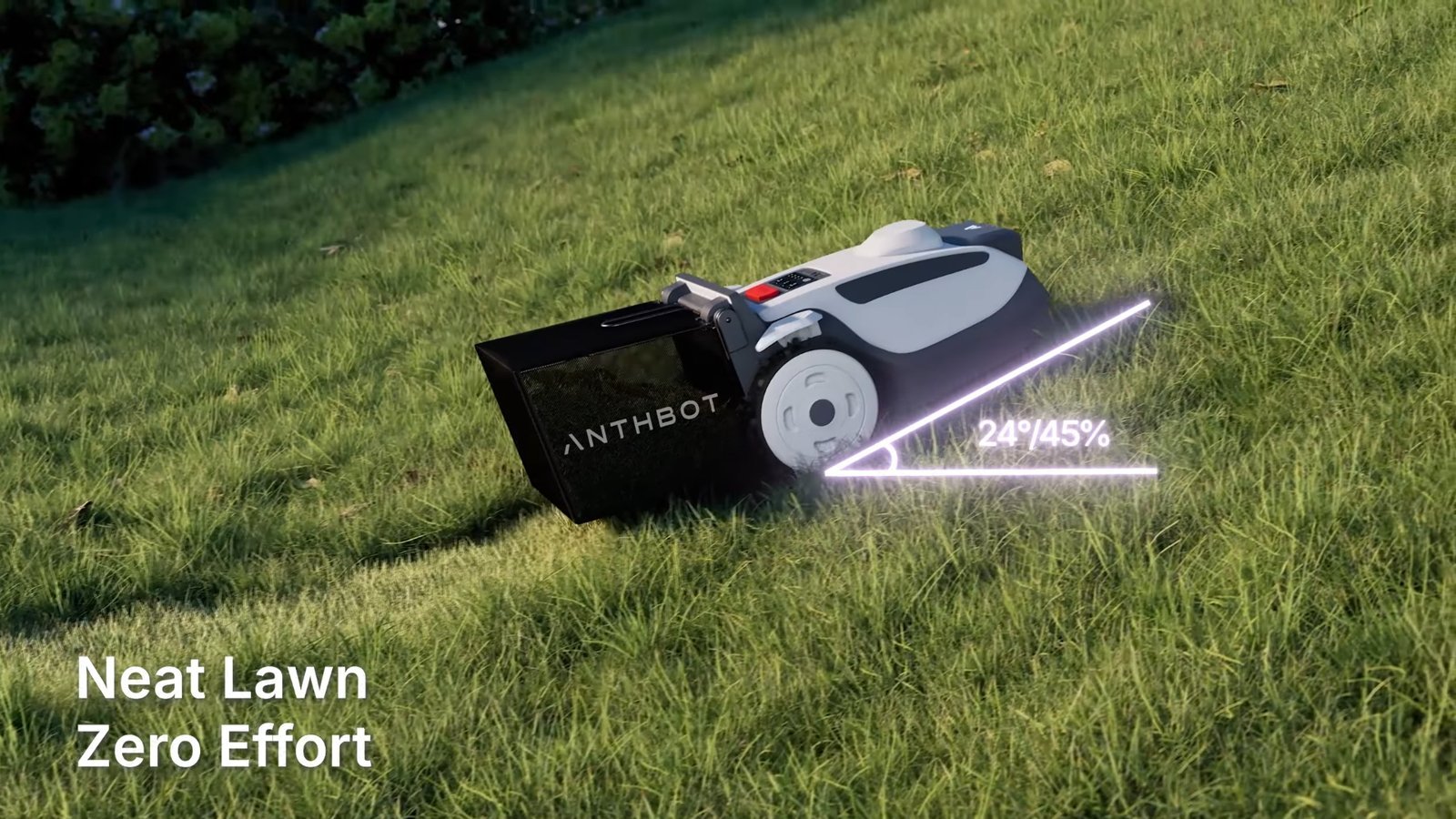
The angle also matters more than people think. Slope steepness is usually given as a percentage, not degrees, and the two don’t move together the way you’d expect. A 45% slope is only about 24 degrees. So a slope that looks gentle can still be near a mower’s limit.
Manufacturers publish their own slope rating, and that’s the number to trust for a specific model. If the manual doesn’t state one, treat the mower as unsuited to anything steep until you confirm it — check the maker’s official product page or the manual itself.
If your slope is dry and under the rated figure, go ahead. If it’s wet, bumpy, or above the rating, don’t.
How to measure your slope before you buy a robot mower
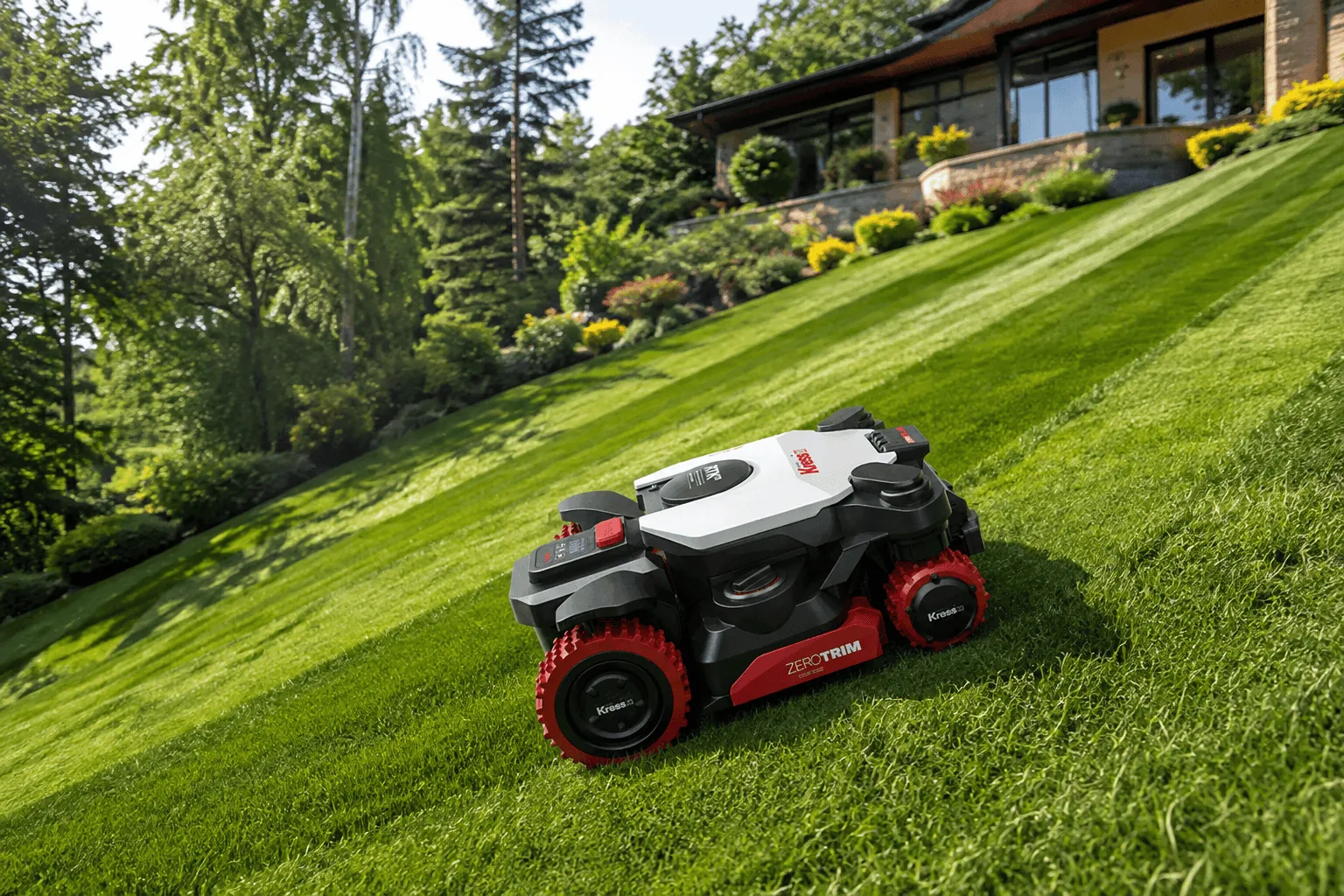
A slope you can’t measure is a slope you can’t match to a mower. Two numbers matter: the percentage grade and whether the surface stays firm and even along the whole run. Here’s how to get both without special tools.
- Measure the rise and run with a level and tape. Hold a 4-foot level flat, find the height difference at one end, and divide that height by 4 feet. Do this at the steepest spot, not the average.
- Repeat the measurement after rain. Walk the same line when the grass is wet and note where your own feet slip. Those are the spots your mower will lose grip too.
- Check the surface for dips and roots. A slope that’s smooth on paper can have a rut that lifts a wheel. Note any bump taller than about an inch.
- Look at what’s at the bottom. If the slope ends at a road, wall, or water, confirm the mower has a drop-off or lift sensor before you rely on it.
- Compare your worst number to the mower’s rating. Use your steepest wet measurement, not your best dry one. If it’s above the rating, that model isn’t for your yard.
The mistake that costs people a mower
The most common error is trusting the box number on a wet day. Someone buys a mower rated for 35%, sets it loose after rain, and watches it slide sideways down the hill. The result isn’t just a missed cut — sliding mowers can run into fences, tip, or roll onto a road.
The cost is real. A mower that slides repeatedly stresses its drive motors and can burn them out, and a machine that tips can be damaged beyond repair. That’s a replacement, not a repair. Some warranties also exclude damage from use on slopes beyond the rated limit, so a slide can leave you paying for a new unit yourself.
The fix is one check: run the mower on the slope only when the grass is dry, and watch the first pass closely. If any wheel spins or the mower drifts sideways, stop. The rating assumed dry ground, and yours isn’t.
When to stop and call someone
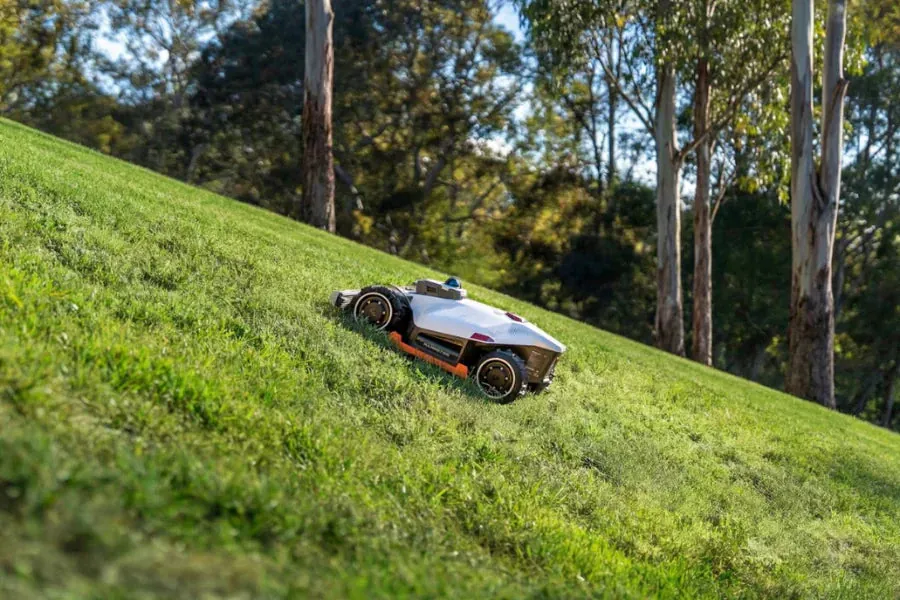
A steep slope stops being a do-it-yourself job the moment a mistake can hurt someone or break something expensive. Watch for these signs.
- The slope ends at a road, water, or a drop — a runaway mower is a safety risk, and a boundary or fence installer handles the barrier.
- The mower slides or tips even when dry — this is beyond the machine’s design, and the maker’s support line can confirm the rating.
- The slope is over 45% — no residential mower is rated for this, and a landscaping or excavation pro can terrace or reshape it.
- You’d need to stand on the slope to guide it — that puts you at fall risk, and a pro with the right equipment should take over.
Never push a mower up a slope by hand to help it. If it can’t climb on its own, the slope is past its limit.
Frequently asked questions
How steep a slope can a robot mower handle?
Most models handle up to about 35%, and all-wheel-drive models often reach 45%. That figure assumes dry, firm, even grass. On wet or bumpy ground, expect the real limit to be lower — sometimes much lower. Always check your specific model’s manual for its exact rating.
Can a robot mower handle a 45-degree slope?
No. If your slope measures near 45 degrees, no robot mower is safe for it.
Why does my robot mower slip on a slope it used to climb?
Wet grass, longer grass, or worn tires cut traction. A tire that’s lost its tread bites less, and damp blades of grass act like a slick layer. Dry the lawn, cut it shorter, and check the tread. If it still slips, the slope is likely past the mower’s real limit.
Is it safe to let a robot mower run on a steep slope?
Only if the slope is within the mower’s rated limit and the ground is dry. A mower that slides can hit people, pets, or property. Check whether your model has a tilt or lift sensor, and keep the slope clear of children and animals while it runs.
How do I measure my slope for a robot mower?
Use a level and tape. Hold a 4-foot level flat, measure the height gap at one end, and divide by 4 feet. Measure at the steepest point, then measure again when wet. Use the wet number to compare against the mower’s rating.
Does tire type matter for slope climbing?
Yes, a lot. Wide, knobby tires grip better than narrow, smooth ones. Tread bites into the grass and pushes the mower up. If your model offers different tires, the grippier set is worth it on any slope above about 20%.
What happens if a robot mower slides down a slope?
It can hit a fence, wall, or road, and it can tip over. Repeated sliding strains the drive motors and may burn them out. Damage from use beyond the rated slope is often not covered by warranty, so a slide can mean paying for repairs yourself.
Do I need an all-wheel-drive robot mower for a slope?
Only if your slope is above about 35%, or if your ground is loose or uneven. On gentle, dry slopes, a two-wheel-drive model is fine. AWD helps most on steep, loose, or bumpy ground where a single driven wheel would spin.
Check your slope, then match the mower
Measure your steepest wet slope first, then compare that number to the mower’s rating before you buy or run it. If the mower climbs cleanly on a dry test pass with no wheel spin, you’re set. If it slides, drifts sideways, or stalls, stop and call the maker’s support line or a landscaping pro — that’s your sign the slope is past what the machine can safely do.

Daniel Carter is a home improvement specialist and tool researcher with years of experience studying power tools, hand tools, workshop equipment, outdoor gear, and DIY projects. At HomeToolWorld, he researches products, compares features, reviews manufacturer specifications, and creates practical buying guides to help homeowners, DIY enthusiasts, and professionals make informed decisions. His goal is to provide accurate, easy-to-understand, and trustworthy content based on careful research and real-world applications.